
Clan MacDougall torpedoed
- heather8820
- Nov 6, 2022
- 4 min read
Updated: Oct 30, 2023
U-106 was a German submarine built in 1940 for Hitler's naval war campaign. Over a period of three years it patrolled the Atlantic Ocean stalking and sinking 22 merchant marine cargo ships, two warships and two oil tankers. It was one of the most successful U-boats of the German fleet. U-106 was responsible for propelling Mexico into the second world war. After the sub torpedoed two oil tankers in the Gulf of Mexico, Mexico declared war on Germany June 1st 1942.
In May 1941, U-106, was patrolling off the coast of West Africa. Under cover of a moonless tropical night, captain, Jurgen Oertsen, spotted an undefended ship, MV Silveryew, a British Merchant Navy vessel, near the Portuguese territory of the Cape Verde Islands. The submarine torpedoed the lone ship just after midnight on 30th May. Fifty one surviving crew took to the lifeboats and they made towards the arid island of Santo Antão (San Antonio).
At the same time a second British Merchant Navy ship, MV Clan MacDougall, was en route from Glasgow to Capetown. It received orders to divert from their planned route and head to the deep port harbour of Mindelo. As they entered the western Cape Verde Islands the ship passed the floating life boats of Silveryew. It was wartime and the rafts were close to landing on San Antonio Island so they did not pick up the survivors. The crew of the Clan MacDougall quickly offloaded some cargo at Sao Vicente Island, refueled, then set off late at night on 30th. They were hoping to continue on to Freetown without encountering any enemy submarines.
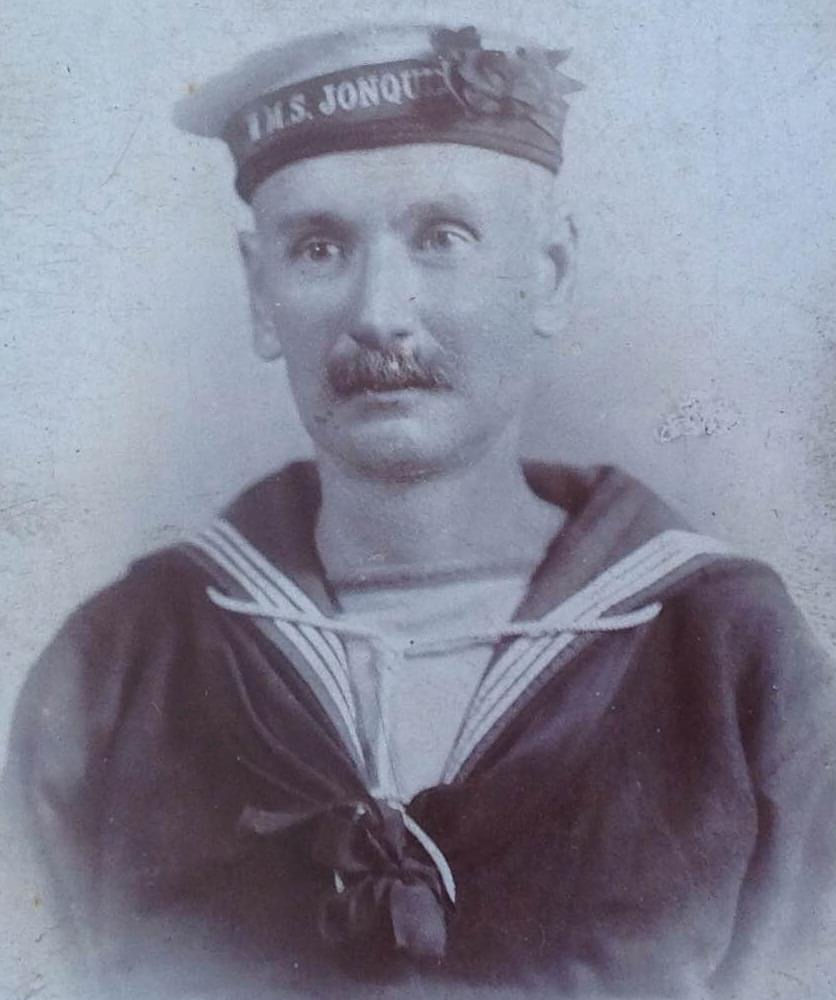
My father Reginald Dodsworth was one of the Clan MacDougall crew. He was an Australian electrician who had joined the Clan Line, one of the companies providing ships for the British Merchant Navy. The first ship he boarded, MV Sterlingshire, previously named Clan McDonald, was torpedoed while crossing the north Atlantic in HX-90 convoy on 2 December 1940. He escaped drowning on that occasion because the heroic captain of Empire Puma broke convoy and rescued survivors from the surging waves. They were delivered safely to Liverpool, England.
Merchant Navy seaman were employees of the shipping company. In those days if the ship they were working on was torpedoed they received no wages after the ship sank because it was considered "non working time". The ship's owner no longer required the seaman's services so there was no requirement to pay the seaman between assignments. Dad had to seek accommodation with relatives in Middlesbrough, Yorkshire and ask his mother in Australia to send money to help him with daily expenses. The British government brought in a new rule mid way through 1941 when they were getting desperate for merchant navy seamen, that forced the shipping companies to pay for time spent in lifeboats or in captivity.
The Clan Line Steamer company lost half their vessels in World War I and II. It is estimated that 27 percent of British Merchant Navy seamen died through enemy action, so sailing in the the Merchant Navy was not only poorly paid but very risky. A few weeks later the company reassigned my Dad to the Clan MacDougall. It departed Glasgow April 30th for the trip to Capetown.
The unescorted ship Clan MacDougall was spotted and followed by U-106. Portugal remained neutral during the war so the submarine captain waited until the ship was in open water before firing. The first torpedo hit at 3:13 AM on May 31st. Two of the crew were lost and 85 men scrambled into four life boats. A second torpedo missed but a third torpedo sank the ship at 3:34 AM. The master, 74 crew members and ten gunners drifted in lifeboats for hours, hoping to reach nearest island San Antonio. They did not disembark because a Portuguese coastal steamer Tarrafal had spotted them and the captain recommended not to land on San Antonio. Not only was it a dry barren island but 51 seamen from MV Silveryew were being rescued. The crew of both wrecked ships landed in Sao Vicente after days in lifeboats.
Mindelo was a small town and there was barely enough food for the locals let alone 136 extra men. Drought, overgrazing, clearing and burning trees for fuel had left the islands desolate and short of food. As well as crop failure, their supply routes had been cut off by the war. In the years 1941-43 and 1947-48, it is estimated that 45,000 people died of famine in the Cape Verde Islands.The shipwrecked sailors camped out on the beach. Some locals assisted them by sharing food, water, clothes and hats to shade them from the blistering sun. The bored crew filled in time catching fish, crabs, shellfish and any unlucky duck or gull. It was a long three months waiting for rescue. The Clan Line was eventually able to send two ships to pick up the survivors. The first took those travelling north in July but those heading south had to wait until August for rescue. My father eventually made it back to Australia working his way home on different ships. He never went to sea again and never ate chicken or fish as it reminded him of the months spent shipwrecked on a desert island.
What happened to U-106? Thanks to Alan Turing and his team at Bletchley Park, the British Defence team cracked the Enigma machine code and deciphered the position of the German submarines. The Royal Air Force was alerted to the presence of U-106 off the coast of Spain. A Sunderland aircraft pilot spotted the submarine, 2 August 1943. It was bombed and sank with the loss of 22 lives. Another 26 were picked up by German E-boats (surface torpedo boats).
My father did not know that the bomb was dropped by the Royal Australian Air Force pilot, Flight Lieutenant A.F. Clarke but if he did, I am sure that he and the surviving Clan MacDougall crew would have bought him more than one round of drinks.


Comments